Summary
The Reynolds number is dimensionless and describes the ratio of inertial forces to viscous forces in a flowing fluid. It is used in many fluid flow correlations and is used to describe the boundaries of fluid flow regimes (laminar, transitional and turbulent). This article will show you how to calculate and interpret the Reynolds number.
Definitions
| : | Pipe Diameter | |
| : | Hydraulic Diameter | |
| : | Particle Diameter | |
| : | Reynolds number | |
| : | Average velocity | |
| : | Average particle velocity | |
| : | Fluid density | |
| : | Viscosity |
Calculation of Reynolds Number
Fluid Flowing in Circular Pipes
The Reynolds number for fluid flowing in a circular pipe may be calculated as follows:
Fluid Flowing in Non-Circular Pipe and Ducts
The Reynolds number for fluid flowing through a non circular channel is calculated by substituting the hydraulic diameter of the flow path for the pipe diameter.
Particle Moving Through Fluid
The Reynolds number for fluid flowing over a particle or a particle moving through fluid is calculated by substituting the diameter of the particle for the pipe diameter, and the velocity of the particle for the fluid velocity.
Reynolds Number and Flow Regime
Flow regimes represent typical flow patterns exhibited by fluids as they flow under differing conditions. Reynolds number is used to describe the boundaries of flow regimes; however care must be taken as there are other factors which may influence the flow regime of a fluid. Generally testing is required to determine the Reynolds number at which the flow regimes occur for a given system.
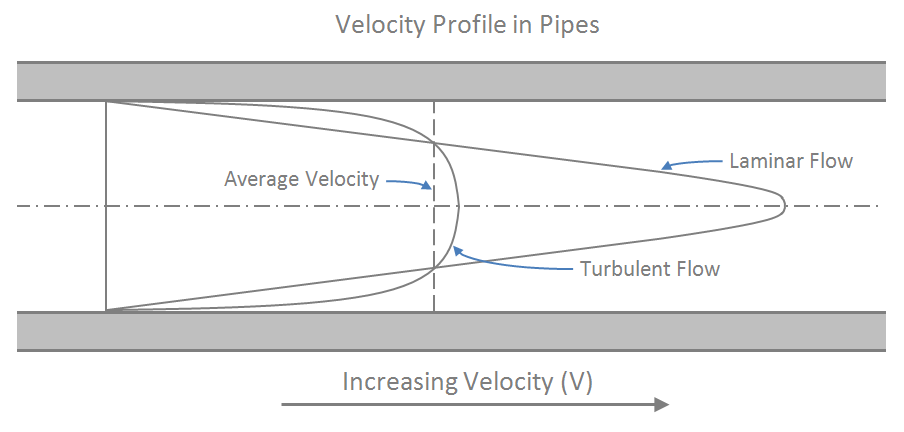
In the case of a straight, non-smooth pipe the flow regimes and their typical Reynolds Number boundaries are shown here.
| Flow Regime | Reynolds Number Range |
|---|---|
| Laminar | |
| Transitional | |
| Turbulent |