Summary
Reading values from a graph or plot with a logarithmic axis visually is difficult and will often result in inaccurate readings. This article presents formulae which may be used with measurements from a graph axis to obtain more accurate values.
Definitions
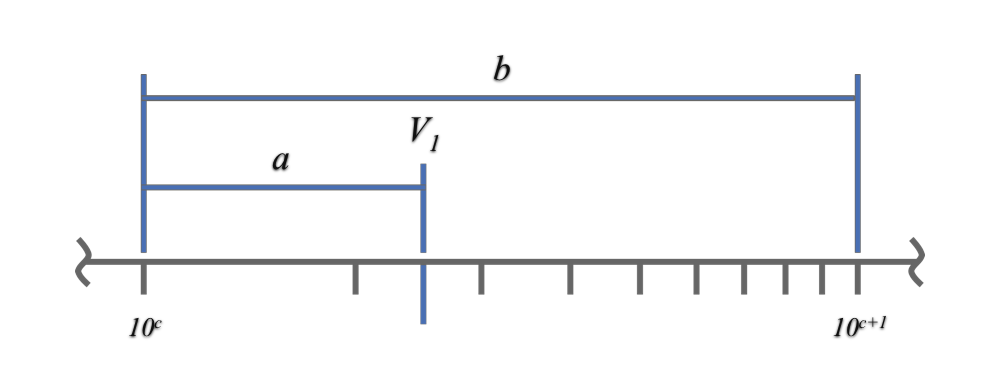
| $a$ | : | Distance between value and lower decade |
| $b$ | : | Distance between two decades |
| $c$ | : | Power of the lower decade |
| $V_{1}$ | : | The unknown value |
| $V_{2}$ | : | A known value |
| $V_{3}$ | : | A known value |
| $x$ | : | The distance between $V_{1}$ and $V_{2}$ |
| $y$ | : | The distance between $V_{2}$ and $V_{3}$ |
Calculate Accurate Values
Using the methods described below we can read accurate values from log plots by measuring the distance of the value from known points on the axis. There are two methods which may be used depending on the information available. Which method is used will depend on whether 2 decades (a decade is a power of 10, for example: 1, 10, 100, 1000, etc) are visible on the axis.
Reading from Plots where 2 Decades are Visible
Good graph designers will ensure they include two decade markers in the axis of their plot. If these are available simply measure the distance between the unknown value and the lower decade, as well as the distance between the two decades and apply the formula below.
$$ \displaystyle V_{1} = 10^{c}10^{a/b} $$
Reading from Plots where One or No Decades are Visible
Often a graph will include only one decade marker, in this case it is impossible to use the simple method described above. To accurately read a value we need to choose 2 points with a known value. Measuring the distance between these two points and the unknown value we can determine an accurate reading using the formula below.
$$ \displaystyle V_{1} = V_{2}^{(x/y)+1} \times V_{3}^{-x/y} $$
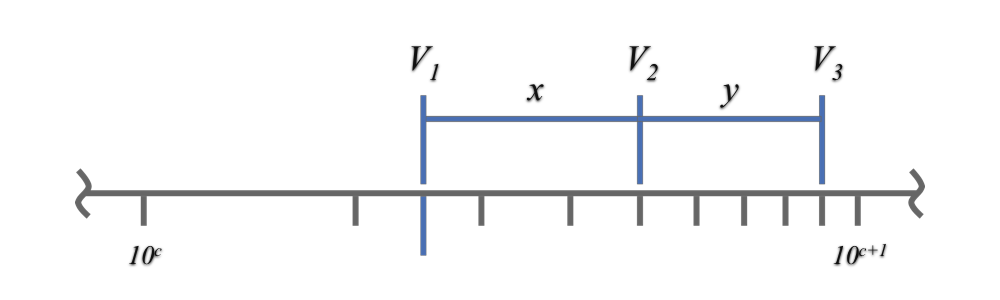
Note that for the formula above the direction of the distance between values is important, for example if $V_{2}$ has a lower value than $V_{1}$ , the distance measured must be taken as a negative. See below for detailed examples.
Examples
Example where 2 Decades are Available
In this example we have a value between the decades 10 and 100 on the scale.

The steps to calculate the unknown value $V_{1}$ are:
- Measure the distance between the value and the lower decade, 10. In this example 9.4.
- Measure the distance between the decades. In this example 24.
- Apply the formula
$$ \displaystyle \begin{aligned} V_{1} &= 10^{x}10^{a/b} \\ &= 10^{1}10^{9.4/24} \\ &=24.6 \end{aligned} $$
Example where no Decades are Available
In this example the graph has been truncated and the decade values are not known.

The steps to calculate the unknown value $V_{1}$ are:
- Measure the distance between $V_{1}$ and $V_{2}$ . In this example -7.3.
- Measure the distance between $V_{2}$ and $V_{3}$ . In this example 6.1.
- Apply the formula
$$ \displaystyle \begin{aligned} V_{1} &= V_{2}^{x/y+1}V_{3}^{-x/y} \\ &= 5^{(7.3/6.1)+1} \times 9^{-7.3/6.1} \\ &=2.5 \end{aligned} $$
Example where no Decades are Available, and the Unknown Value is Between the Known Values
In this example the graph has been truncated and the decade values are not known, and the unknown value falls below the known values.
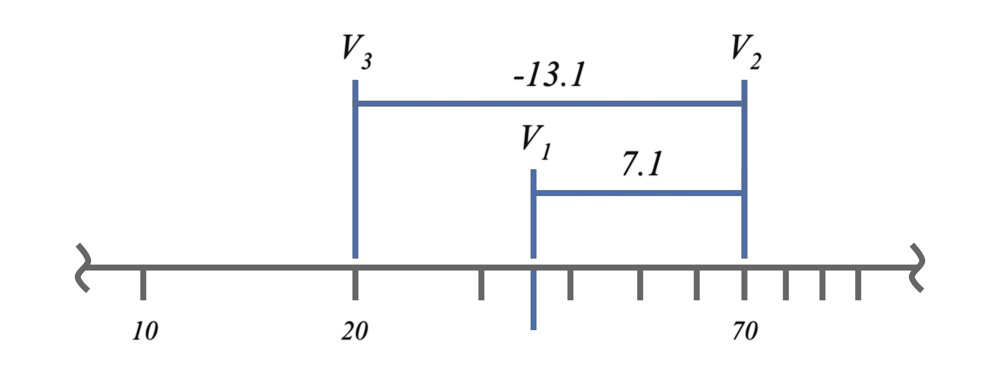
The steps to calculate the unknown value $V_{1}$ are:
- Measure the distance between $V_{1}$ and $V_{2}$ , in this example -7.1.
- Measure the distance between $V_{2}$ and $V_{3}$ , in this example 13.1.
- Apply the formula
$$ \displaystyle \begin{aligned} V_{1} &= V_{2}^{x/y+1}V_{3}^{-x/y} \\ &=70^{(-7.1/13.1)+1} \times 20^{-7.1/13.1} \\ &=35 \end{aligned} $$
Example where no Decades are Available, and the Unknown Value is Higher than Both Known Values
In this example the graph has been truncated and the decade values are not known, and the unknown value is greater than both known values.
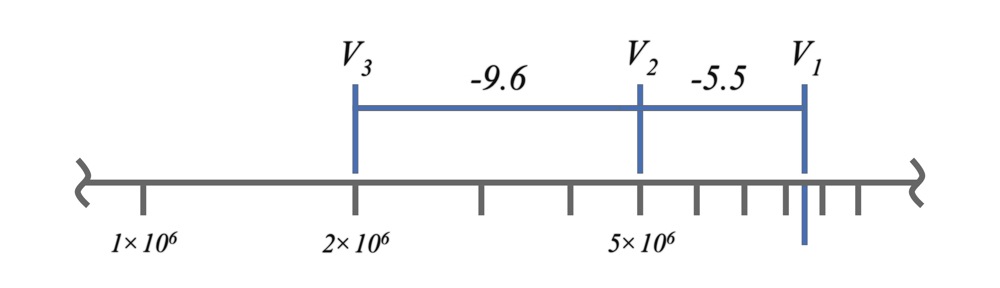
The steps to calculate the unknown value $V_{1}$ are:
- Measure the distance between $V_{1}$ and $V_{2}$ , in this example -5.5.
- Measure the distance between $V_{2}$ and $V_{3}$ , in this example -9.6.
- Apply the formula
$$ \displaystyle \begin{aligned} V_{1} &= V_{2}^{x/y+1}V_{3}^{-x/y} \\ &=(5\times 10^6)^{(-5.5/-9.6)+1} \times (2\times 10^6)^{-5.5/-9.6} \\ &=8.5\times 10^6 \end{aligned} $$
In this case the negative signs will cancel out, and the positive values may have been used instead and the same result achieved. However, if you always you always include the correct sign when calculating these values you may help avoid mistakes.
Article Tags