Summary
Henry’s Law describes the relationship between the solubility of a gas in a liquid and the partial pressure of that gas above the liquid surface. A range of experimentally determined Henry’s constants are tabulated and can be used to determine the solubility of various gas species in water.
Definitions
| : | Concentration (moles per volume) | |
| : | Henry’s Constant | |
| : | Partial Pressure | |
| : | Pressure | |
| : | Mole Fraction in Liquid |
Subscripts:
| : | Aqueous Phase | |
| : | Gaseous Phase |
Introduction
Henry’s law tells us that the amount of gas that will dissolve in a liquid is proportional to the pressure of the gas. More specifically Henry’s law states that at a constant temperature, the amount of a given gas that dissolves in a given type and volume of liquid is directly proportional to the partial pressure of that gas in equilibrium with that liquid.
Formulations of Henry’s Law
Several formulations of Henry’s Law exist and therefore care must be taken to ensure that the Henry’s constant selected matches the formulation of Henry’s law employed in solubility calculations. The various formulations of the Henry’s Law constant are shown below.
| Form | Equation | Notes |
|---|---|---|
| Concentration over Pressure | Often used by Atmospheric Chemists | |
| Mole Fraction over Pressure | Often taught to Chemical Engineers | |
| Dimensionless | – | |
| Molality per Pressure | – |
Henry’s Solubility and Henry’s Volatility
The above relationships are often called Henry’s solubility. When these relationships are inverted (e.g. ) they are referred to as Henry’s Volatility and the inverse constant may be presented.
Assumptions
Henry’s law was developed for real gases and liquids, but typically for low concentrations of solutes in water. Thus, the constants are generally only accurate while there is a low concentration of the component in question.
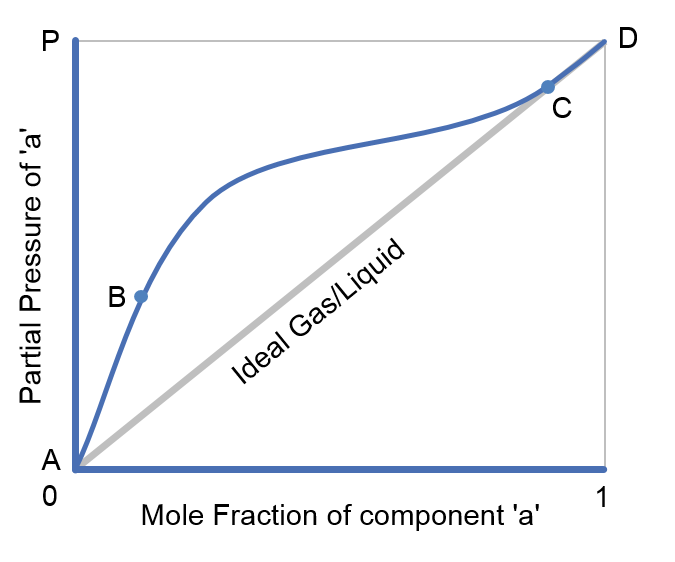
Henry’s law is typically accurate along the A-B line for component ‘a’ in the above graph.
Henry’s Constant
The table below gives some typical values for Henry’s Constant for a species dissolved in water at low concentration and 298.15 K.
| Species | (mol m⁻³ Pa⁻¹) | (mol L⁻¹ atm⁻¹) | (–) | (mol kg⁻¹ atm⁻¹) | (atm⁻¹) |
|---|---|---|---|---|---|
| Nitrogen | 6.40 × 10⁻⁶ | 6.48 × 10⁻⁴ | 1.59 × 10⁻² | 6.50 × 10⁻⁴ | 1.17 × 10⁻⁵ |
| Oxygen | 1.30 × 10⁻⁵ | 1.32 × 10⁻³ | 3.22 × 10⁻² | 1.32 × 10⁻³ | 2.38 × 10⁻⁵ |
| Argon | 1.40 × 10⁻⁵ | 1.42 × 10⁻³ | 3.47 × 10⁻² | 1.42 × 10⁻³ | 2.56 × 10⁻⁵ |
| Carbon Dioxide | 3.30 × 10⁻⁴ | 3.34 × 10⁻² | 8.18 × 10⁻¹ | 3.35 × 10⁻² | 6.04 × 10⁻⁴ |
| Neon | 4.50 × 10⁻⁶ | 4.56 × 10⁻⁴ | 1.12 × 10⁻² | 4.57 × 10⁻⁴ | 8.24 × 10⁻⁶ |
| Helium | 3.90 × 10⁻⁶ | 3.95 × 10⁻⁴ | 9.67 × 10⁻³ | 3.96 × 10⁻⁴ | 7.14 × 10⁻⁶ |
| Methane | 1.40 × 10⁻⁵ | 1.42 × 10⁻³ | 3.47 × 10⁻² | 1.42 × 10⁻³ | 2.56 × 10⁻⁵ |
Refer to this compilation of values for a much more extensive list.
Conversion Factors
The factors below can be used to convert between different forms of Henry’s Constant.
| (mol m⁻³ Pa⁻¹) | (mol L⁻¹ atm⁻¹) | (–) | (mol kg⁻¹ atm⁻¹) | (atm⁻¹) | ||
|---|---|---|---|---|---|---|
| (mol m⁻³ Pa⁻¹) | ||||||
| (mol L⁻¹ atm⁻¹) | ||||||
| (–) | ||||||
| (mol kg⁻¹ atm⁻¹) | ||||||
| (atm⁻¹) |
