Discharge Coefficient

The pressure drop or flow rate through a valve or orifice plate is typically calculated using the a flow coefficient, Cv or orifice diameter. This article demonstrates how to convert between these two parameters when performing functions such as selecting a valve with an equivalent pressure drop to a given orifice plate.
Definitions
| : | Orifice diameter (m) | |
| : | Flow coefficient, US imperial units | |
| : | Discharge coefficient, dimensionless | |
| : | Ratio of orifice to pipe size , dimensionless |
Subscripts
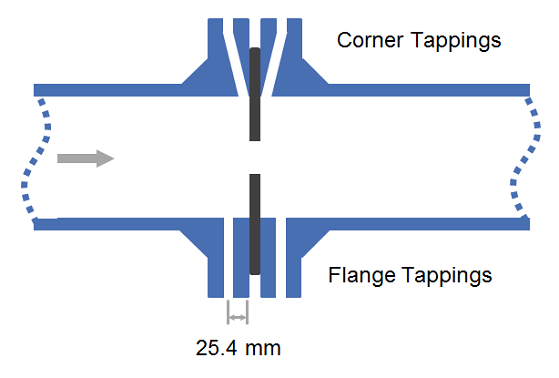
The discharge coefficient is a dimensionless number used to characterise the flow and pressure loss behaviour of nozzles and orifices in fluid systems. Orifices and nozzles are typically used to deliberately reduce pressure, restrict flow or to measure flow rate. This article gives typical values of the discharge coefficient for common orifice and nozzle designs.
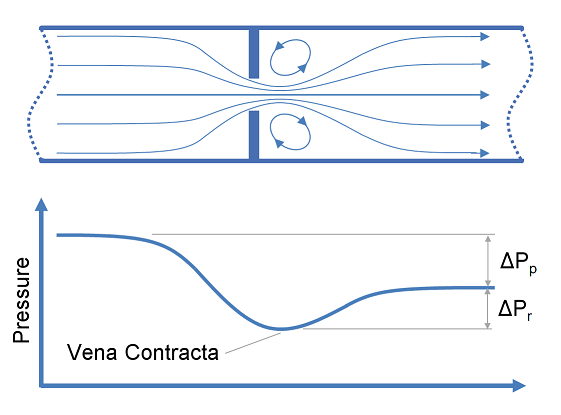
This article provides calculation methods for correlating design, flow rate and pressure loss as a fluid passes through a nozzle or orifice. Nozzles and orifices are often used to deliberately reduce pressure, restrict flow or to measure flow rate.
Definitions
| : | Diameter | |
| : | Area | |
| : | Discharge coefficient | |
| : | Gravitational acceleration | |
| : | Fluid head | |
| : | Change in fluid head | |
| : | Ratio of specific heats ( ) | |
| : | Pressure | |
| : | Differential pressure ( ) | |
| : | Expansion coefficient ( for incompressible flow) | |
| : | Elevation | |
| : | Ratio of pipe diameter to orifice diameter ( ) | |
| : | Mass density |
Subscripts: