Speed of Sound
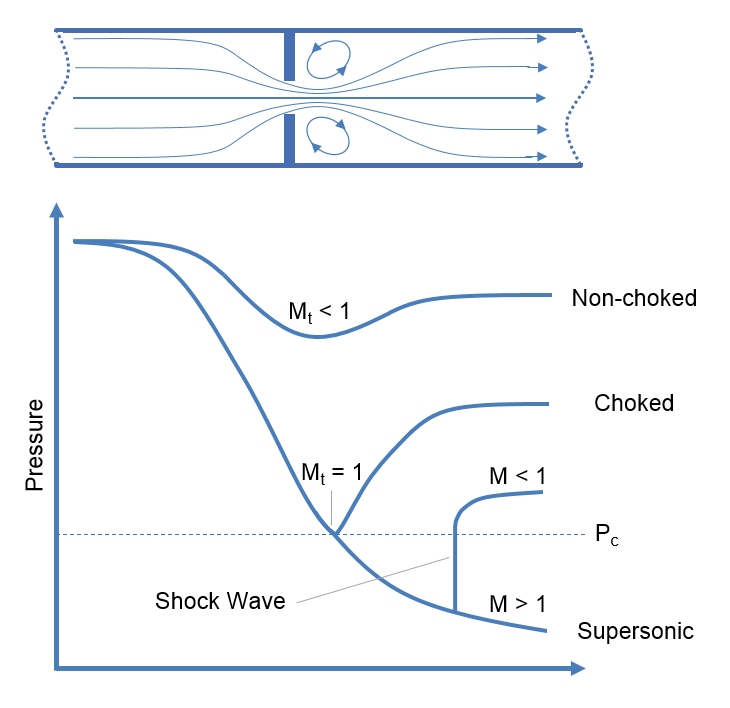
Choked flow is a phenomenon that limits the mass flow rate of a compressible fluid flowing through nozzles, orifices and sudden expansions. Generally speaking it is the mass flux after which a further reduction in downstream pressure will not result in an increase in mass flow rate.
Definitions
| : | Cross sectional area | |
| : | Coefficient of Discharge | |
| : | Mass flux | |
| : | Resistance coefficient | |
| : | Index of polytropic change | |
| : | Mach number | |
| : | Pressure | |
| : | Velocity | |
| : | Mass flow rate | |
| : | Expansion coefficient | |
| : | Ratio of heat capacities, | |
| : | Specific gravity |
Subscripts
| : | Upstream conditions | |
| : | Downstream conditions | |
| : | Choked conditions | |
| : | Throat (minimum flow area) conditions |
Introduction
Non-choked Flow
As a compressible fluid passes through a restriction there are changes in both velocity and pressure. The fluid starts upstream at a higher pressure, which falls as it increases velocity flowing through the restriction, and may continue to fall as the velocity increases through the vena contracta. After passing the vena contracta the fluid will begin expand to fill the cross sectional area of the pipe and as it does will slow down and regain pressure.
The Mach number is the ratio of the relative velocity of a fluid to the local speed of sound. This article provides the equation for the calculation of the Mach number and a discussion of its uses.
This article provides the formulae for the calculation of speed of sound in fluids and fluid filled circular pipes. The speed of sounds is important in piping systems for the calculation of choked flow for gases and pressure transient analysis of liquid filled systems.